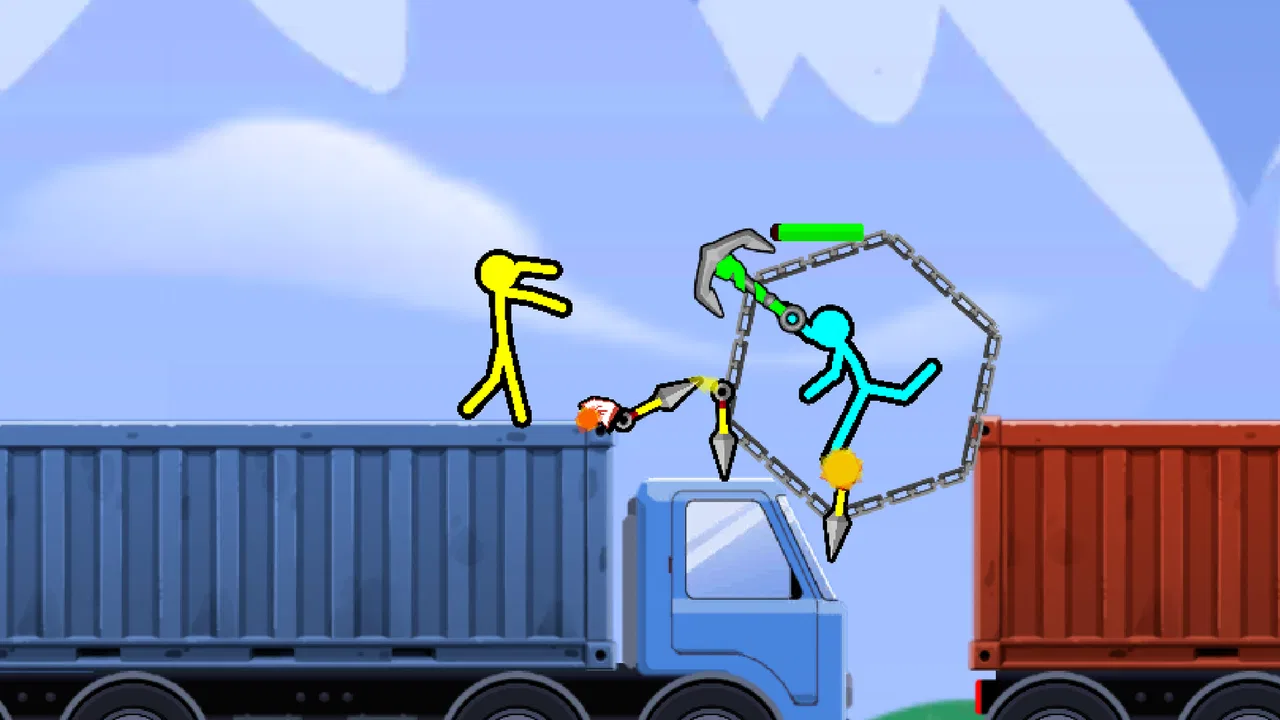
Supreme Duelist
- 4.5
- Rating
- 100.00M
- Installs
- Free
- Price

 Analysis by App-foxy
I picked up Supreme Duelist expecting a quick action game and found something that works best when I stop treating each match as a serious competition. Its appeal is immediate: enter a fight, make a move, react to the opponent, and see how the exchange ends. When it goes badly, the reset is quick enough that I usually want another attempt instead of putting the phone down.
That simple rhythm explains why this funny fighting game has reached more than 100 million installs and holds a 4.5 average from around 2 million ratings. I would not describe it as a deep fighting simulator, and that is important. It is closer to a compact playground for short bouts, playful mistakes, and repeated rematches. The developer, Neron's Brother, has focused the experience on getting into the action rather than surrounding it with a complicated presentation.
Why the first action matters
The first thing I notice in a game like this is how long it takes to reach the part that matters. Here, the value is in the fight itself. I can start experimenting almost immediately, which makes the game a natural choice when I have only a few minutes. There is no need to reserve a long evening for it; a short break can be enough for several attempts, especially once I understand how the controls respond.
You May Also Like

 Blood Strike: 2.5 Anniversary
Blood Strike’s Loadouts Turn Every Drop Into a Tactical Gamble
A close look at Blood Strike’s custom loadouts: how fast access to signature weapons reshapes its battle royale rhythm, rewards preparation, and narrows the gap between fights.

 Pandora - Music & Podcasts
Pandora’s Music Is Easy to Start, but Harder to Recover
Pandora’s strength is its low-effort path from a seed to a station. Its weak spot is how much confidence it asks you to place in connection, setup, and quiet recovery.

 8 Ball Pool
 Is Built on Rivalries, Rematches, and Routine
A close look at the rivalries, rematches, shared routines, and unanswered safety questions that turn a quick pool match into a persistent mobile community.

 Samsung Music
’s Quiet Strength Is Playing What You Already Own
Its reach comes less from spectacle than from dependable access to a personal library. That simplicity is both the app’s strongest retention engine and its ceiling.

 AccuWeather: Weather Radar
AccuWeather Review: A Quick, Clear Forecast for Everyday Decisions
For everyday plans, the best forecast is the one you can understand quickly. AccuWeather makes rain timing, radar, and local conditions easy to act on, with a few trade-offs.

 Hill Climb Racing
Why Hill Climb Racing Still Turns Crashes Into One More Run
A tiny car, a bumpy hill and one more upgrade: Hill Climb Racing keeps resurfacing because its simple chaos makes every near-miss feel personal.
More From Our News Desk



The action has a deliberately playful feel. Characters and movement do not ask me to approach every exchange with the precision of a traditional competitive fighter. Instead, the fun comes from seeing how a basic decision develops. I move, attack, adjust, and sometimes create an outcome that feels more amusing than planned. That unpredictability gives the game its personality, while the direct controls keep the learning curve approachable.
I found the best way to begin was to avoid button-mashing for a few rounds. The first matches are more useful when I watch the distance between fighters and notice what happens after an attack misses. A careless move can leave me exposed, while a patient response often creates a better opening. This is one of the game’s less obvious strengths: it looks silly, but it still rewards paying attention to timing and position.
That balance makes it suitable for players who want action without a large ruleset. Someone new to mobile fighting games can understand the basic objective quickly, while a more experienced player can still enjoy trying to control the pace of a bout. The ceiling is not the same as a dedicated fighting game with a large roster and a carefully developed competitive system, but the lower barrier is exactly why I can recommend it for casual play.
A useful first-session habit
My practical advice is to spend the opening matches learning what the game considers a safe distance. Do not rush to attack every time the opponent is nearby. Watch how far a movement carries the character, how quickly an action ends, and whether a missed attempt gives the other side an easy chance. These small observations make later rounds feel less random without turning the experience into homework.
This approach also helps answer a question many new players have: is the game easy to understand? Yes, at the basic level. The challenge is not figuring out a complex menu of systems; it is making better choices inside a very small amount of time. That distinction matters. I can explain the goal quickly, but improving my results still depends on reading the situation rather than simply repeating the same action.
The feedback rhythm keeps each bout moving
The strongest part of the experience is the feedback loop. I perform an action, see an immediate consequence, and decide whether to change direction or try again. That response is clear enough to keep me involved, but light enough that a mistake does not feel punishing. A successful exchange gives me a little satisfaction, while a ridiculous failure often becomes a reason to restart rather than a reason to quit.
This rhythm is especially effective on a phone. Mobile games can lose me when controls feel delayed or when a round spends too much time preparing for the fun. Supreme Duelist benefits from keeping attention on the next decision. I am rarely wondering what I should be doing in a broad strategic sense; I am thinking about the next movement, the next attack, and whether I should take a risk.
The feedback is also social even when I am playing alone. The exaggerated fighting style makes a win feel entertaining rather than merely efficient. If I am showing the game to a friend, the appeal is easy to understand because a match can produce a funny result without requiring a long explanation. That makes it more approachable than many serious action games, where a newcomer may need several rounds before the basic excitement becomes visible.
There is a trade-off here. The same simplicity that makes the game welcoming can limit its staying power for players who need a large amount of progression or a highly technical combat system. After the novelty of the movement and exchanges settles, I have to enjoy the act of replaying fights for its own sake. If I need a long campaign, detailed character development, or a carefully structured competitive ladder, this is probably not the right action game for me.
Where the feedback becomes useful
I get more from each match when I treat it as a small experiment. If an attack fails, I ask whether the problem was distance, timing, or impatience. If a move works, I try to understand why instead of assuming it will always work. This turns the game’s short bouts into a practical learning cycle: test something, observe the result, and adjust during the next attempt.
That method is also useful for playing with a friend. Rather than immediately trying to win every round, we can agree to test different approaches and see which choices create the most interesting exchanges. Because the game is funny and fast, losing does not necessarily end the session. A poor result can still produce a memorable moment, which is a valuable difference from action games where defeat feels like wasted time.
For younger players, the Everyone content rating makes the game easier to consider as a family-friendly action option. I would still expect the usual need for sensible supervision around mobile play and spending, but the tone is much lighter than a violent or mature fighting title. The game’s humor and accessible structure are more important to its identity than realism.
The reward is the next interesting exchange
One of the game’s unusual qualities is that its reward is not only a formal result. Winning matters, of course, but I often keep playing because the previous round created a possibility I want to try again. Perhaps I mistimed an attack, found a better position, or saw an amusing interaction that could have ended differently. The reward is partly the feeling that the next bout might produce a cleaner or funnier outcome.
This is why the game works well in short everyday situations. If I am waiting for a meeting to begin, taking a break between tasks, or sitting somewhere with a few spare minutes, I can play without committing to a lengthy narrative. A single round can provide enough entertainment, and a sequence of rematches can fill more time if I am in the mood. The game does not demand that every session have a major objective.
The free price makes that low-commitment approach easier. I can try it without paying an entry cost, while optional in-app purchases are listed at $4.99 per item. I appreciate that the basic invitation is straightforward, but I would still advise checking the purchase controls before handing the phone to a child. The game is most appealing when I choose to keep playing because the matches are enjoyable, not because a purchase feels necessary to make the experience worthwhile.
That leads to an important question: does it feel like a game built around spending? My experience is better when I judge it as a free, repeatable action toy rather than as a progression-heavy product. The core reason to return is the combat loop itself. Players who want a constant stream of unlocks, equipment upgrades, or a large collection to manage may find the reward structure too light. Players who enjoy replaying a compact challenge can find the lack of clutter refreshing.
Three ways I use it differently
- Quick reaction practice: I play a few rounds while focusing on one behavior, such as waiting for an opening instead of attacking immediately. This gives a short session a clear purpose.
- Pass-the-phone entertainment: I use rematches as a simple shared activity because a newcomer can understand the action without studying a long tutorial or story.
- Reset after a frustrating game: I use the next bout to test one small change rather than trying to recover a perfect record. That keeps a loss from taking over the whole session.
These uses reveal a trade-off that is easy to miss in a basic store summary. The game is not necessarily rewarding because it steadily transforms my character or account. It rewards me through immediate feedback and the chance to make a better decision next time. That is a strong design choice for casual players, but a weak fit for anyone who needs a visible long-term journey.
Why the reset is part of the fun
The reset after a match is not just a practical convenience; it is central to the game’s appeal. When a round ends, I do not feel that I have lost a large investment of time. I can immediately reconsider what happened and start again. That keeps failure emotionally small while preserving enough tension for a win to feel satisfying.
I find this particularly helpful when playing on a busy day. In a longer action game, a defeat may mean repeating a substantial section or waiting through several screens. Here, the compact structure makes experimentation comfortable. I can try a risky move, see the consequence, and decide whether the idea was bad or simply badly timed. The reset turns mistakes into information.
There is also a social benefit. If a friend wins, I am more likely to request a rematch because the result does not create a long pause. The same is true when I win: the other player can try a different approach without feeling that the session has reached a final conclusion. This makes the game more suitable for informal competition than for players who prefer a single, high-stakes match.
Still, fast resets can expose the limits of the design. If I am not enjoying the actual movement and combat, there is no larger story or elaborate progression structure to pull me forward. Restarting only feels good when the previous exchange gave me something to think about or laugh at. Once that reaction disappears, the loop can become repetitive.
When another action game is better
I would choose a different game if my priority were a serious esports-style experience, a deep single-player campaign, or a complex roster with extensive mastery paths. Supreme Duelist is not trying to replace those alternatives. Its strength is the opposite: it reduces the distance between opening the app and having a playful fight.
I would also skip it if I dislike physics-driven surprises or if I need highly predictable controls in every situation. The charm comes partly from outcomes that do not always look perfectly controlled. That can be entertaining for a casual session, but frustrating for someone who wants every result to follow a precise competitive formula.
On the other hand, I would pick it over a larger fighting game when I want something that starts quickly and does not require remembering a long list of commands. It is also a better fit when the goal is to share a few laughs with another person rather than build a serious ranking. Knowing that distinction prevents disappointment: this is a compact action playground, not a replacement for every kind of fighter.
What keeps me coming back
The reason another session begins is simple: the last exchange rarely feels completely final. I may have lost because I acted too early, won because the opponent made a mistake, or discovered a move that deserves another test. The game turns that unfinished feeling into momentum. I am not chasing a long checklist; I am chasing a slightly better attempt or a more entertaining outcome.
That loop of action, feedback, reward, and reset is unusually clean. The action gives me something immediate to do. The feedback tells me whether the choice helped. The reward is a win, a funny moment, or a new idea. The reset removes the cost of trying again. When all four parts line up, a short mobile game can feel more satisfying than a much larger one that spends too long preparing its content.
The current version is 4.0.5, and the game supports devices running Android 6.0 or later. Those details matter if I am installing it on an older phone, since compatibility can be more important than the game’s modest presentation. I would also remember that performance and comfort can vary by device, so a player who is sensitive to controls should judge the actual feel on their own handset rather than assuming every phone will respond identically.
Its popularity gives me confidence that the central idea has broad appeal, but popularity does not remove the need to match the game to the right player. A 4.5 average and roughly 36 thousand written reviews suggest a strong response from its audience, yet a player seeking deep progression can still find the experience too narrow. I see those facts as evidence of a successful casual formula, not proof that it covers every preference within the action category.
My verdict after settling into the loop
I recommend Supreme Duelist to anyone who wants a free, funny fighting game for quick sessions, friendly rematches, and low-pressure experimentation. Its best moments come from the immediate relationship between a decision and its consequence. I can make a move, learn from the result, and start again before frustration has time to build.
I would be more cautious with players who expect a substantial campaign, detailed competitive depth, or a strong long-term progression system. The game’s simplicity is both its clearest advantage and its main limitation. It does not hide that trade-off, and I think it is better to understand it before installing rather than expecting a full-scale fighter.
For me, the final judgment is positive because the reset never feels like a chore. The game earns another session by making the next attempt feel close, funny, or worth testing. That is a modest goal, but it achieves it well: quick action, readable feedback, a small reward, and an immediate invitation to try once more.
FAQs for Supreme Duelist
01What is Supreme Duelist Stickman?
Supreme Duelist Stickman is a fast-paced action game available on Android and iOS. It features stickman characters engaging in intense duels using a variety of weapons and environments. The game offers both single-player and multiplayer modes, allowing players to challenge friends or AI opponents in a fun and competitive setting.
02How do I play Supreme Duelist Stickman with friends?
To play with friends, you can use the local multiplayer mode. Simply connect two devices via Bluetooth or use the same device in split-screen mode. This feature allows you to engage in real-time battles with friends side by side, adding a layer of excitement and competition to the game experience.
03What are the controls like in Supreme Duelist Stickman?
The game offers intuitive and simple controls, making it accessible to players of all skill levels. You can move your stickman by dragging your finger across the screen, while tapping will execute attacks. The controls are responsive, ensuring a smooth gameplay experience. Customizable control options are also available to suit personal preferences.
04Does Supreme Duelist Stickman have in-app purchases?
Yes, Supreme Duelist Stickman includes in-app purchases that allow players to buy cosmetic items and enhancements. These purchases are optional and don’t affect the core gameplay. Players can enjoy the full experience without spending money, but the purchases can add a personalized touch to your stickman characters.
05Are there any age restrictions for Supreme Duelist Stickman?
The game is rated for ages 9 and up due to mild violence depicted in cartoonish form. Parents may wish to review the content if they are concerned about younger children playing. The game’s focus on strategy and reflexes makes it suitable for a wide audience, but parental guidance is recommended for younger players.
Pros
- Engaging multiplayer battles
- Simple and intuitive controls
- Wide variety of weapons
- Customizable characters
- Offline mode available
Cons
- Limited map selection
- Ads can be intrusive
- Occasional lag issues
- No detailed tutorials
- Limited character customization

Supreme Duelist
Gallery